Halachot in the tradition of our Chachamim from Morocco
Dozens of Audio & Video Shiurim by Rabbi Mordechai Lebhar
Hilula of Moroccan Tzadikim
Sefarim based on our Morrocan Minhagim
Monthly Sponsor: Available
Weekly Sponsor: Available
Sponsor of the Day: Available
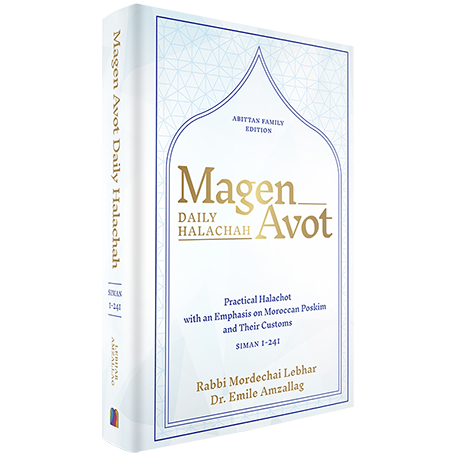
Magen Avot - Daily Halacha
Click here to purchase
Daily Moroccan Halachot
Rabbi Mordechai Lebhar, author Magen Avot
Redacted by Dr. Emile Amzallag

DAILY HALACHOT PODCAST  ON APPLE
  ON SPOTIFY
Daily Halachot Topics
The Shulhan Aruch (Orah Haim 120:1), quoting the Gemara (Berachot 55), says that if one had a bad dream which caused one great distress one shouldgo before three people, preferably who like him, and should say “I saw good dream”, and they should reply “it’s a good dream”. This process is known as “Hatavat Halom”, the rendering good of a dream. Rabbi Yosef Leib Bloch (Shiurei Da’at, vol. I) explains that a dream is a message from Hashem which is capable of being healed, as it were. It is up to the dreamer to address this dream and seek out three colleagues, and by doing so, one turns the dreaminto a positive message. Many Siddurim, including Moroccans ones, have a longer text of the Hatavat Halom which includes different verses and is longer than the very concise version that is written in the Shulhan Aruch. The longer text is based on what is recorded by the Arizal (Peri Etz Haim, Sha’ar Hazarat HaShatz, ch. 7) and the Kaf HaHaim (O.H. 220:11). It is worthwhile to note that there are many different types of dreams. The Ramhal (Derech Hashem: Dreams) mentions dreams of insignificance, for example things that one may have seen during the day, or things he may have eaten, or angels putting in falsehoods in one’s dreams. Nonetheless, if one has a dream that he feels has truth and appears to be concerning, this could be a message from Hashem and he should perform the Hatavat Halom. Another remedy for a bad dream is recorded in the Shulhan Aruch (Orah Haim 130:1), which says that during the auspicious time during which Birkat Kohanim takes place, one should recite a special prayer (written in many Siddurim) to remedy one’s bad dream. Rabbi Moshe Toledano (Shamayim Hadashim, § 66), citing the Magen Avraham, discusses a situation in which one cannot find three people for Hatavat Halom. In such a case, one can do it in front of two people and then do it again in front of a third person. Even though all three people were not present at the same time, it appears that doing it in such a fashion is also acceptable. The Elya Rabba, quoting the Shela, states that one may do Hatavat Halomeven on Shabbat. The rationale is that a bad dream can cause a person extreme anxiety and thus remedying the dream is a type of Pikuah Nefesh, preservation of life, which is permitted on Shabbat. Summary:Someone who had a truly distressing dream should performHatavat Halom. The Shulhan Aruch (Orah Haim 123:1) says that one and one’s wife should recite the blessing of “Hatov Vehametiv” after the latter gives birth to a boy. Generally speaking, this blessing is recited in situations in which there is an exceptional level of joy. This blessing has the status of Reshut, which means that it is not obligatory but rather optional. Although the birth of a girl can be as joyous or more so than that of a boy, onedoes not recite this blessing when one has a daughter. The Mishna Berura(O.H. 123:2) explains that even if one had multiple boys and had the merit of having a girl, thus fulfilling the Mitzvah of Peru Urvu, one would not recite HatovVehametiv. Nevertheless, he writes that just as one recites “Sheheheyanu” when seeing one’s friend after at least thirty days, and certainly having a baby daughter is not less joyous than this, one could recite Sheheheyanu on the birthof a girl. It does appear, however, that nowadays people are not particular about reciting either of these blessings when they have a new boy or girl. Furthermore, the Sephardic custom is to recite Sheheheyanu at the Brit Milaand the Poskim explain that this blessing takes the place of Hatov Vehametivfor a boy. Regarding a girl, if one is very joyous one may recite Sheheheyanu. Since this is not customary nowadays, and if one is in doubt as to whether onemay recite it, one can wear a new article of clothing and recite Sheheheyanu on that and have the birth of the girl in mind. The birth of a sibling or a grandchild does not warrant either blessing since it is not Halachically considered a joy that directly impacts a person. Nonetheless, the HIDA (Commentary to Sefer Hasidim, § 843) writes that one may recite a blessing without Hashem’s Name. Summary: Hatov Vehametiv is not typically recited over the birth of a boy. The custom nowadays is to recite Sheheheyanu at the Brit Mila of a boy. One may recite Sheheheyanu if one is very joyous about the birth of one‘s girl. In general the blessing of “Sheheheyanu” is recited on recurring events, such as holidays, as well as on joyous occasions. This blessing is also recited when one derives benefit from something. For example, the Shulhan Aruch (Orah Haim 223:2), based on the Gemara (Berachot 59b), writes that if one’s father passes away (h’v) and one was left with an inheritance, one should reciteSheheheyanu. If one had brothers who also inherited money from the father, the Shulhan Aruch continues, one would recite “Hatov Vehametiv” instead of Sheheheyanu. The Mishna Berura (O.H. 223:9), citing the Rashba (Shu”t HaRashba, § 245), says that although one would prefer that one’s parents notpass away and to forego any inheritance, in any event the blessing that is recited is not one of joy but rather of benefit, in this case money, that comes along with the passing of one’s parents. Despite the Mishna Berura’s clarification, it may still appear insulting to a father’s memory to recite Sheheheyanu on an inheritance. Indeed, Rabbi Shlomo Zalman Auerbach (Halichot Shlomo, Berachot) writes that the common custom nowadays is not to recite this blessing. Furthermore, according to Rashi (s.v. “Ulebasof”, Berachot 59b), one recites a blessing when one hears that one’s father passed away and was left with an inheritance. Rabbi Ya’akov Hagiz of Fes (Hilchot Ketanot) deduces from Rashi that if one knew about an inheritance before the passing of one’s father, then there is not such a feeling of benefit or excitement and as such one would not recite a blessing. Rabbi Yosef Berdugo (Divrei Yosef , § 4) understands Rashi differently and says that even ifone knew of an inheritance prior to one’s father’s passing, it is not a guarantee that the money is still present and that it may have been squandered or lost. As such, he disagrees with Rabbi Yosef Bedugo’s position and says that onewould still recite Sheheheyanu. Both would agree, however, that if one knew that the inheritance money was being held in a secure place such as a bank, one would not recite the blessing. This corroborates Rabbi Shlomo Zalman Auerbach’s claim that this blessing is not commonly recited anymore. The Shulhan Aruch (Orah Haim 223:3) says that another situation in which Sheheheyanu is recited is if one builds or buys a house to live in. Although the Ben Ish Hai questions whether this blessing should be recited, Rabbi Ovadia Yosef (Hazon Ovadia Berachot) rules that one may rely on the Shulhan Aruchand recite it. Even if one takes out a mortgage to finance the purchase of the house, it is still considered to be a joyous endeavor, and thus one may reciteSheheheyanu. On the other hand, buying a house as an investment, such as to rent out or to sell at a profit, or if re-building a house that burnt down, would notwarrant the recital of a blessing. Summary: The custom nowadays is to not recite “Sheheheyanu” if onereceives an inheritance from a parent that passed away. One may recite“Sheheheyanu” if one builds or buys a new home to live in, even if it involves taking out a mortgage The Shulhan Aruch (Orah Haim 223:4–5) writes that when one acquires certian items, one recites “Sheheheyanu”, and if others benefit from it as well, one recites “Hatov Vehmetiv”. Nevertheless, it goes on to say (ibid:6) that items which do not bring one significant joy, such as a night robe or ordinary shoes,do not warrant any blessing. What is and is not considered significant is obviously open to interpretation and is subject to debate among the Poskim. For example, Rabbi Alexander Mandelbaum (Vezot Haberacha, pg. 166) says that a hat, a wig, a Tallit, a suit or a dress are examples of significant items that would warrant a blessing upon their acquisition. Rabbi Moshe Feinstein (Igrot Moshe, vol. III, Orah Haim, § 80) writes that one may recite “Sheheheyanu” after buying a car, and if others will benefit from it, such as family members who will be transported in it, one would recite “Hatov Vehametiv”. On the other hand, Rabbi Moshe Malka (Mikve Hamayim, vol. IV, pg. 31) reasons that when one purchases a car, one does not attain the level of joy as when one actually starts to drive the car, and that when one finally drives the car, it is not considered new. As such, he writes that one should not recite “Sheheheyanu” on a car. This reasoning is questionable, as people tend to be able to drive the car soon after its purchase, and thus, one may rely on the opinion permitting the recital of a blessing. It should be noted that the blessing would also apply to purchasing a used car, but not to a leased car. Not withstanding, the Ben Ish Hai (Parashat Re’eh, § 5), citing the Magen Avraham (O.H. 223:5) writes that besides, a new suit and the like, the common custom is to not recite a new blessing on new items. Some explain the Ben Ish Hai’s position by saying that it is unclear what is considered a significant item and that it is a subjective interpretation. Interestingly, the Magen Avraham (O.H. 175:???) as well as Rabbi Ben Zion Abba Shaul (Or LeZion, vol. II, ch. 14) write that whenever one has a doubt regarding the blessing of Hatov Vehametiv, one may have it in mind when reciting “Hatov Vehametiv” during Birkat Hamazon. Summary: There is a Halachic basis for reciting “Sheheheyanu” or “Hatov Vehametiv” when one acquires new items such as a car, a piano, a suit etc. The Rosh (Berachot, ch. 9, § 3) writes that the custom in Ashkenazic lands was to not recite Birkat Hagomel when traveling between different locales, unless the travels include passing through the wilderness with wild animals. On the other hand, he says that the custom is Spain was to recite the blessing on any trip because travel is inherently dangerous. He concludes that if one travels the distance of a Parsa, or 72 minutes, one should recite Hagomel, and if one travelled an especially dangerous journey of even less than a Parsa, one should recite the blessing. The Shulhan Aruch (Orah Haim 219:7) quotes the Rosh almost verbatim and gives both the Ashkenazic and Sephardic customs. Rabbi Ovadia Yosef (Yabia Omer, vol I, Orah Haim, § 13), Rabbi Yehoshua Maman (Emek Yehosha, vol. I, 41 ), Rabbi Baruch Toledano (Kitzur Shulhan Aruch, pg. 256) and others write that Birkat Hagomel should be recited on any journey that is at least 72 minutes in length, even if it is one’s daily commute to work. This position appears questionable, because the dangers mentioned by the Rosh included wild animals and bandits, which are hardly threats nowadays. Although there are hazards involved with driving, such as accidents, it is unclear if the blessing was instituted specifically for animals and bandits, or any possible danger. Indeed, Rabbi Ben Zion Abba Shaul (Or LeZion, ch. 13, § 43) writes that the blessing was not intended for the collisions and the like, and only applies to travel where there is a high risk of bandits or pirates attacking the driver. When asked about the Sephardic custom, Rabbi Yosef Shalom Elyashiv also stated that one should not recite Hagomel if there are no wild animals or bandits. It should be noted that either opinion is halachically legitimate. Regarding airplanes, even many Ashkenazic opinions say is to recite Birkat Hagomel because it is comparable to a boat, and a sea travel is one of the four main classes of situations warranting this blessing. Although airplanes do not travel in the sea, they are compared to boats because both modes do not travel on land. Indeed, Rabbi Moshe Feinstein (Igrot Moshe, vol. II, Orah Haim, § 59) says that any flight warrants the blessing of Hagomel. Others say that nowadays, air travel is very safe and the risk of accidents, hijackings, etc. is very low and thus no blessing should be recited. Nevertheless, the rule of thumb is that if one flies across an ocean then one should recite Hagomel, and if one travels between two close cities, then one should follow one’s custom regarding driving. Summary: Depending on one’s custom one may or may not recite Birkat Hagomel traveling by car for more than 72 minutes. One should recite Birkat Hagomel on long–haul flights, but some are lenient with regards to short flights. The Shulhan Aruch (Orah Haim 224:8), based on the Gemara (Berachot 58a) rules that if one sees a Jewish king, one should recite “Baruch Ata…Shehalak Mikvodo Lire’av” (lit. “Blessed art Thou….Who has apportioned of His glory to those who fear Him”) and for a non-Jewish king, one should recite “Baruch Ata…Shenatan Mikvodo Lebasar Vadam” (lit. “Blessed art Thou…Who gave of his glory to flesh and blood). The Shulhan Aruch (ibid:9) goes on to say that it is a Mitzvah to make an effort to see a king, even a non-Jewish one because it is inspiring and implants in one’s heart the concept of Hashem’s kingship and glory Rabbi David Cohen-Scali (Kiryat Hana David), a rabbi in Oran, Algeria, discusses the Halachic implications of the president of France’s visit to his city in 1930. The first issue was that the president was travelling in a horse carriage and was not physically seen by onlookers, as such there is doubt as to whether one could recite the blessing. Regarding this, the HIDA (BIrke Yosef, § 224) writes that if one only sees a king’s entourage but knows that the king is present in the entourage, one may recite the blessing. The second issue is whether a president has the status of a king, who is defined as a leader who has the authority to decree capital punishment. Presidents, prime ministers and the like, on the other hand, are usually accountable to a legislative body and cannot simply decree the death penalty. Rabbi David Cohen-Scali cites the Magen Avraham and the Radbaz, who discuss army generals that do not have authority and the conclusion is that a blessing is not recited. Nevertheless, there are opinions that if a leader has the authority to grantclemency for someone who was sentenced to capital punishment, such as the president of the United States, the blessing may be recited. Furthermore, Rabbi Ovadia Yosef (Hazon Ovadia, Hilchot Berachot, pg. 413) says that if a president or prime minister has the authority to declare war without going through a legislative body, one may recite the blessing. Regarding modern-day kings and queens like Mohammed VI or Elizabeth II, respectively, who evoke a sense reverence and royalty when they are seen, one should recite the blessing. While some posit that a blessing would not be recited if the king or queen is not dressed in their royal garb, Rabbi Meir Mazuz (Elyashiv HaKohen, vol. II) and Rabbi David Yosef (Halacha Berura, vol. XI, pg, 306) point out that by not wearing their garb they are trying to go incognito or blend into a crowd. However, if they normally dress in civilian clothing and certainly if they are surrounded by their royal entourage, the blessing should be recited. Summary:One should make an effort to see kings and queens. Onemay recite the aforementioned blessing when one sees a bona fide kingor queen, or on a national leader who has the authority to grant clemencyin a capital case. The Shulhan Aruch (Orah Haim 224:13) rules that, regarding all blessings that involve seeing different things (such as seeing a king, or the other phenomenadiscussed in Siman 224), one makes a blessing only once every thirty days. In other words, if one were to see a king several times in a week, for example, one would only recite the blessing when seeing him the first time or after thirtyfrom the time one saw the king last. The rationale is that a blessing is onlyrecited when one experiences a sense of newness when one sees something, and this is Halachically defined as being only once every thirty days. If, however, one were to see different kings even within thirty days, one would recite the blessing for each king. Another blessing in this category of things that are seen is recited when onesees Jewish graves or a Jewish cemetery, and is discussed in the Gemara (Berachot 59a) and codified in the Shulhan Aruch (ibid:12). One common trend nowadays is for people to go on excursions to visit the graves of differentprominent rabbis, such as in Israel or Morocco. There is discussion as to whether, here too, a blessing should be recited each time one sees a differentgrave. Rabbi Avraham Azoulay (gloss to the Levush, § 224) quoting the Radbaz (Shu”t HaRadbaz, § 562), writes that if one should recite a new blessing for each new grave that one saw, even if it was within thirty days. Even though Rabbi Yaakov Hagiz (Hilchot Ketanot, vol. I, § 212) says that if one were to see more than one grave one would not repeat the blessing, the HIDA (Birke Yosef, § 224:5), also citing the Radbaz, rules that one would do so. Indeed, many Aharonim agree with this positon, including Rabbi Ovadia Yosef (Hazon Ovadia, Hilchot Berachot, pg. 417), and this appears to be the accepted Halacha. It should be noted that this refers to graves found in differentlocations; if one remains in the same cemetery, only one blessing is recited every thirty days. On a Kabbalistic level, Rabbi Avraham Azoulay and the HIDA (Birke Yosef, § 7) explain that when one visits a grave one should place one’s left hand on the grave and recite a verse from Yeshayahu 58:11. This verse has fifteen words and when reciting it, one should have in mind the fifteen different joints of one’s hand. When one sees the grave of a non-Jew one should recite the verse from Yirmiyahu 50:12. Summary: If one visits the graves of different rabbis (or Jews in general) in different locations, one may recite a blessing for each grave. One blessing is recited within the same cemetery, however. The Gemara (Berachot 58b) and the Shulhan Aruch (Orah Haim, 225:8) say that one who sees all sorts of peculiar types of human beings, such as one who is lack, red, or white, or who is very small should recite “Baruch Ata…Meshane Haberiot” (“Bless are Thou…Who changes the creations”). On the surface it seems offensive to make a blessing based on one’s race, but Rashi comments that the Gemara does not refer to one that would be known today as “Black” (African ancestry) or “White” (European ancestry). Rather the Gemara refers to one who is abnormally dark or light and the like. As a matter of fact, Rabbi Ya’akov Hagiz (Hilchot Ketanot) says that the Gemara refers to someone black who was born to white parents, or vice versa. The Shulhan Aruch continues by saying that this blessing is also recited when one sees an elephant or a monkey. Thus one would be able to recite this blessing at a zoo if one see the aforementioned animals. Furthermore, the Shulhan Aruch (ibid:10) says that if one sees beautiful trees, or beautiful people, even non-Jews, one recites “Baruch Ata…Shekacha Lo BeOlamo” (Blessed art Thou…Whose universe is such”). Since normally it is forbidden for a man to gaze an unknown woman, and much less recite a blessing, it is explained that what’s involved is not staring, but rather a quick glance. Nevertheless, it does not appear that the recital of this blessing is common nowadays. Rabbi Avraham Danzig (Haye Adam) explains that this blessing can only be recited once in one’s lifetime. Since one likely saw beautiful trees or people previously and did not recite a blessing, one missed the opportunity. The Sha’ar Hatziun (O.H. 225:33) says that people nowadays lack the capacity to judge who or what is truly beautiful and deserving of a blessing. However, one is permitted to recite the blessing without Hashem’s Name. Regarding today’s (August 21, 2017/29 Av, 5777) solar eclipse, Rabbi Haim Kanievsky was asked whether a blessing is recited just as it is for other rare phenomena like comets and rainbows. He quotes the the Gemara (Sukkah 29a) which says that when the sun is “struck”, that is, is eclipsed by the moon, it is a bad omen for the world, and as such,a blessing should not be recited. Summary: If one sees very beautiful animals, trees or people, one can recite“Baruch Shekacha Lo BeOlamo”, omitting Hashem’s Name. A blessing is not recited of a solar eclipse. The Shulhan Aruch (Orah Haim 228:1) says that when one sees rivers, seas and mountains one should recite “Baruch Ata…Oseh Ma’ase Bereshit” (”Blessed art Thou…Who makes the works of Creation”). If one sees the the Mediterranean Sea after not having seen it for at least thirty days, one recites “Baruch Ata…Oseh Hayam Hagadol” (“Blessed art Thou…Who creates the great sea”). However, there are many opinions that this latter blessing applies to the oceans as well. Since the Mediterranean is at once a regular sea and “the great sea”, there is an opinion to recite the blessing of “Oseh Hayam Hagadol” immediately followed by the words “Oseh Ma’ase Bereshit” and as such, both opinions are fulfilled. The Rock of Gibraltar is located in such a way that a person standing atop it could see both the Mediterranean Sea and the Atlantic Ocean. According to the Shulhan Aruch, one could rely on the Mediterranean side to recite “Oseh Hayam Hagadol”, and according to the other opinions one could rely on the Atlantic side. Practically speaking though, “Oseh Hayam Hagadol” only applies to the Mediterranean sea. Regarding rivers, the Shulhan Aruch (ibid:2) only includes those rivers that are mentioned in the story of Creation (Euphrates, Tigris, Pishon and Gihon) which are located in modern-day Iraq. As for mountains, not only are the great ranges like the Alps, Himalayas, Andes, etc. included in the blessing of “Oseh Ma’ase Bereshit”, but Rabbi Ben Zion Abba Shaul (Or LeZion ch. 46, § 62) says that Mount Hermon in Israel is also included. Furthermore, the blessing is also recited on canyons or great trenches and therefore one would be able to recite this blessing on the Grand Canyon or Niagara Falls. Summary: When one sees the Mediterranean Sea one recites “Oseh Hayam Hagadol”. When one sees oceans, tall mountains or canyons, one recites “Oseh Ma’ase Bereshit”. The Shulhan Aruch (Orah Haim 227:1) says that if one witnesses thunder or lightning, one should recite the blessing “Baruch Ata…Oseh Ma’ase Bereshit” (”Blessed art Thou…Who makes the works of Creation”) and that if one one wishes, one may also recite “Baruch Ata…Shekoho Ugvurato Male Olam” (“Blessed art Thou…Whose strength and might fill the universe”). The Mishna Berura (O.H. 227:5) clarifies that the custom nowadays is for the blessing of “Oseh Ma’ase Bereshit” to be recited specifically upon seeing lightning, while the blessing of “Shekoho” is recited when one hears thunder. Furthermore, Rabbi Eliezer Waldenberg (Tzitz Eliezer, vol. XII, § 21) states that regarding lightning, the blessing may be recited not only if one sees the bolt of lightning, but even flashes of lightning in the sky. The Mishna Berura’s position seems to be the accepted custom, but it should be noted that the blessings must be recited immediately after witnessing these phenomena. Nevertheless, Rabbi Shalom Messas (Shemesh Umagen, vol. IV § 6), Rabbi Machlouf Abuhatzira (Yefe Sha’ah, § 23) and Rabbi Baruch Toledano (Kitzur Shulhan Aruch, § 113) all write that the custom in Morocco was to recite these blessings without Hashem’s Name. Other Sephardic rabbis, including the Ben Ish Hai (Parashat Ekev, § 16), concur. Rabbi Haim Pontremoli (Petah Hadevir, § 227) writes that one rationale is because the average person is not proficient in reciting the blessing within the allotted time after witnessing thunder or lightning and as such, it is preferable to not include Hashem’s Name. The Kaf Hahaim suggests that these blessings have the status of Reshut, or being voluntary, and therefore people did not normally take it upon themselves to recite it. Rabbi Shalom Messas, citing the Ramban, suggests that any Mitzvah which does not have an action does not require a blessing with Hashem’s Name. However, this is a questionable rationale since one does say Hashem’s Name upon seeing the Mediterranean Sea, etc., which also does not involve any actions. Rabbi Ben Zion Abba Shaul (Or LeZion, vol. II, § 14:47) writes that, although the common custom is to not mention Hashem’s Name when reciting the blessings over thunder and lightning, there is a Halachic basis if one does recite it with Hashem’s Name. (As a clarification, “without Hashem’s Name” refers to omitting the words “A-donai” and “E-lohenu Melech HaOlam” in a blessing). Summary: The common custom is to recite the blessings over thunderand lightning without Hashem’s Name. However, one who recites these blessings with Hashem‘s Name has what to rely on.Bad Dreams
Blessings on Births
“Sheheheyanu” on an Inheritance
Sheheheyanu on Different Items
Traveling
Blessing on Kings
Blessing on Graves
Blessing on Beautiful and Peculiar Creatures
Blessings on Geological Phenomena
Blessings on Thunder and Lightning
Sign up for the Daily Moroccan Halachot Email