Halachot in the tradition of our Chachamim from Morocco
Dozens of Audio & Video Shiurim by Rabbi Mordechai Lebhar
Hilula of Moroccan Tzadikim
Sefarim based on our Morrocan Minhagim
Monthly Sponsor: Available
Weekly Sponsor: Available
Sponsor of the Day: Available
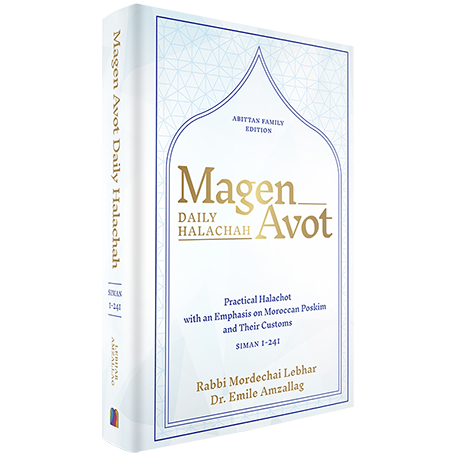
Magen Avot - Daily Halacha
Click here to purchase
Daily Moroccan Halachot
Rabbi Mordechai Lebhar, author Magen Avot
Redacted by Dr. Emile Amzallag

DAILY HALACHOT PODCAST  ON APPLE
  ON SPOTIFY
Daily Halachot Topics
The Rambam (Hilchot Berachot, 8:2) rules that the blessing over olive oil is “Shehakol”, unless one drinks it to cure a throat ache, in which the blessing would be “HaEtz”. Nevertheless, the Shulhan Aruch (Orah Haim 202:4) says that, since olive oil has a detrimental effect to one’s health, one would not recite any blessing before drinking it. If one were to mix the olive oil with something else, however, the Shulhan Aruch says that one would recite “HaEtz”. Rabbi Baruch Toledano (Kitzur Shulhan Aruch, §199:16) explains that nowadays it is common for people to consume olive oil and that not only is it not harmful, but on the contrary, many doctors recommend it. As such, he writes that the appropriate blessing would be “HaEtz”. The Ben Ish Hai (Shana Alef, Parashat Pinhas, § 9) rules similarly. On the other hand, Rabbi Ovadia Yosef (Yabia Omer, vol. VI, § 48:6) challenges this approach based on the ruling of the Shulhan Aruch. Nevertheless, there are grounds for supporting the opinion of Rabbi Toledano and the Ben Ish Hai since the olive oil on the market today is much more refined and less acidic than what used to be available previously. Even though Rabbi Ben Zion Abba Shaul (Or LeZion, ch. 14, § 1) rules like Rav Ovadia Yosef and suggests that today’s olive oil may still have unknown harmful effects, there is sufficient support to recite “HaEtz”. Summary: There is a Halachic foundation for reciting “Bore Peri HaEtz” when consuming olive oil. The Shulhan Aruch (Orah Haim 204:5) writes that nowadays, wine is not as sharp as in earlier times and thus it is important to be conscious of how much water is used to dilute it, lest it require the blessing of “Shehakol” and not “HaGefen”. The Rama (ibid.) adds on that as long as wine constitutes at leastone sixth of the mixture, its blessing would remain “HaGefen”. This is based on a teaching in the Gemara (Bava Batra 96b) that says that as long as the mixture contains a sixth of wine and tastes as such, its blessing would remain “HaGefen”. The Mishna Berura (O.H. 204:31) clarifies that the Rama is referring to actual wine that is being diluted, and not wine dregs, whose dilutionfactor is smaller because of their milder quality. Nevertheless, the Kaf HaHaim (O.H. 204), basing himself on the Peri Megadim, says that nowadays at leasthalf of the mixture should be wine. Rav Ovadia Yosef concurs with this approach. Practically speaking, as long as wine makes up at least half amixture and tastes like wine, the blessing of “HaGefen” could be recited. The Gemara (Bava Batra 97b) also says that one who squeezes grapes recites “HaGefen” on the resultant juice. Although grape juice is not wine, it has the potential of fermenting and thus our Sages also included it in the blessing of “HaGefen”. Having said that, Rabbi Shlomo Zalman Auerbach and Rabbi Yosef Shalom Elyashiv maintain that since grape juice is weaker than wine, anydilution will nullify its Gefen status. Indeed the well known kosher grape juiceproducts such as Kedem and Welch’s are marketed co There is a product known as “Kedem Lite” which is marketed as having less sugar and fewer calories as the classic Kedem grape juice. There are some Poskim who say that its blessing should be “Shehakol” since it contains roughly 40% water, whereas others say that since the grapes used are more concentrated than conventional grapes, it would remain “HaGefen”. Since there is disagreement in the matter, one should avoid using Kedem Lite, for the Gefen, although onewho uses it does have on what to rely. Summary: One could recite “Bore Peri HaGefen” on a mixture of wineand water that contains at least 50% wine. Any dilution of grape juice is renders the mixture questionable vis–a–vis reciting “HaGefen” and shouldbe avoided. The Shulhan Aruch (Orah Haim 206:4) says that whenever one is reciting a blessing over a food or a fragrance, one should hold it in one’s right hand. The Mishna Berura (O.H. 206:18) explains that the right hand is considered more important and as such it is fitting for to use it for blessings. The Mishna Berura quotes an opinion from and rules like Rabbi Akiva Eiger, who says that with regards to a leftie, one’s left hand is more dominant and therefore one would use that hand for the blessing. Nevertheless, the Kaf HaHaim says that even in such a case, a leftie should still use the right hand because according to Kabbalah, the right hand represents the attribute of Hesed (kindness) and is preferable over the left hand. The Mishna Berura goes on to say that when one is given a Sefer (in this context, Sefer refers to a book of Hebrew religious literature), one should accept it with one’s right hand. Rabbi Haim Kanievsky says that just as with reciting blessings, one should accept a Sefer with one’s dominant hand, but when it comes to taking a Torah scroll, one should always use one’s right hand. Another related Halacha is that one should hold whatever one is reciting a blessing over. The Mishna Berura (O.H. 206:17) says that one reason is that by holding it, one has proper intent while reciting the blessing. Elsewhere in the Shulhan Aruch, the Mishna Berura (O.H. 167:22) says that another reason is that by holding the food or fragrance, one minimizes the possibility of a disruption between the blessing and the consumption of whatever one is holding. If one recites a blessing while the object was not in one’s hand but rather is laid down on a table or other surface, the blessing is still valid, Bediavad (ex post facto). Although there is no clear Moroccan custom, most Sephardic authorities, including the Kaf HaHaim and the Sde Hemed say that one should use one’s right hand while reciting a blessing, regardless of one’s dexterity. Summary: While reciting a blessing one should hold the food, drink or fragrance with one;s right hand, even if one is a leftie. One should hold a Torah scroll in one’s right arm. The blessing of “Al HaMihya” is part of a class of blessings known as Me’enShalosh which also includes the after-blessing for wine (“Al HaGefen”) and for certain fruits from the Land of Israel (“Al HaEtz”). When one has a requisiteamount of one or more of these types of foods, one would recite all the applicable parts of Me’en Shalosh. For example, if one ate a Kazait of cake and drank a Revi’it of wine, one would recite “Al HaMihya ve’al Hakalkala ve’al HaGefen ve’al Peri HaGefen”. The Shulhan Aruch (Orah Haim 208:18) deals with a situation in which one had the requisite amount of one type of food, say cake, but not of another, like wine. In such a situation, one would only recite the appropriate part of Me’en Shalosh, in this case “Al HaMihya” and would not be permitted to add the “Al HaGefen”. Nevertheless, Rabbi Avraham Encaoua (Kerem Hemer, Orah Haim, § 8) says that one may add a blessing to the Me’en Shalosh, even if one did not have the Halachically-required amount. Since one is reciting Me’en Shalosh anyway for food that was definitely eaten in the required amount, it gives one the opportunity to thank Hashem for other types of food that were not Halachically sufficient. It should be noted that there is not an obligation to make this addition, but rather one may added if one wishes, according to this position. Moshe Feinstein (Igrot Moshe, Orah Haim , vol. II, §109) concurs with this opinion. Rabbi Ovadia Yosef (Hazon Ovadia, Berachot, pg. 200-201) challenges this position by saying that although one may make additions to prayer, one may not do so to blessings, and that adding “Al HaGefen” for example, would be considered a Hefsek, an interruption. Since he says that there is a disagreement in the matter, he concludes that if one consumed an amount of food that was on the lower end of opinions of the Halachically required amount, one would be able to add in the other blessing. In other words, some opinions hold that a Kezait, for example, could be as low as 18 grams and so if one had a Revi’it of wine, one would be able to add on “Al HaMihya” to the “Al HaGefen” blessing. Summary: If one recites Me’en Shalosh after eating a requisite amount of food, there is a Halachic basis upon which to rely if one wishes to add on the appropriate part of Me’en Shalosh for other types of foods even if the requisite amount was not consumed. The Shulhan Aruch (Orah Haim 210:1) writes that the minimum volume required to recite an after-blessing on a beverage is a Revi’it (that is, a Rev’it, or a quarter, of a Log). The Rambam defines a Revi’it as being equivalent to 27 Dirhams, and Rabbi Haim Naeh (Shiure Torah) says that one Dirham is equal to 3.2 cc. According to this reckoning, it follows that a Revi’it is equivalent to 86.4 cc. Interestingly, Rabbi Hadar Margolin and other rabbis explain that archaeological artifacts suggest that the Dirham is actually equivalent to as little as 2.7 or 2.8 cc, and therefore a Revi’it would be closer to 75 cc. Rabbi Yehezkel Landau (Tziun LeNefesh Haya, Pesachim 109a) argues that the volume of Revi’it used to be larger and that the Revi’it nowadays should actually be double its current amount, which would be at least 150 cc. Rabbi Yedidya Monsenego (Dvar Emet, § 1) argues this opinion and writes that the volume nowadays should actually remain as they are. Rabbi Shalom Messas (Mikraei Kodesh, Pesach) agrees that this is the common practice. Accordingly, a Revi’it is 86 cc., and in light of recent findings, it is as low as 75 cc. Summary: One may recite a Beracha Aharona after drinking at least 75cc. of liquid. The previous Halacha mentioned that fortunate occurrences that do not deviate from the normal course of nature are not considered miracles for the purpose of reciting the blessing of “She’asa Li Nes Bemakom Ze” with Hashem’s Name. Nevertheless, if one experiences anything that one would personally classify as a miracle, whether supernatural or something that fits in the normal course of nature, one should hold a Seudat Hoda’a, a meal of gratitude. Rabbi Yair Bachrach (Havot Yair) writes that such a meal has the status of a Seudat Mitzvah. The Mishna Berura (O.H. 218:32) adds that on the anniversary of the miracle, one should give charity specifically to those who study Torah, and should consider it in place of the Korban Toda (lit. Thanksgiving Offering) and one should even read the Torah portion dealing with this offering. Furthermore, he says that one should donate money for one’s city’s communal needs or public works. The Kaf HaHaim (O.H., § 39), citing the Zohar, explains that one has an obligation to publicize the miracle that one experienced annually, on the anniversary of the occurrence. By doing so on Earth, the angels join in publicizing the miracle in the Heavens and Hashem’s Name becomes exalted. The Kaf Haim (O.H. 218:9) also writes that there if a particular community experienced a salvation from a communal calamity, there is a custom not to recite Tahanun on the anniversary of the day of the miracle. Summary: One should hold a Seudat Hoda’a if one experienced a personal miracle, and one should give money to charity. It is also important to publicize this miracle annually. Although the Shulhan Aruch does not specifically mention whether or not women are obligated in Birkat Hagomel, and Rabbi Haim Benveniste (Knesset Hagedola, § 219) says that there is no difference between women and men and they are equally obligated. The Magen Avraham (219:1) on the other hand, says that Birkat Hagomel has the status of “Reshut”, or a voluntary prayer, and thus women are not obligated in reciting it. Rabbi Eliyahu Spira (Elya Rabba 219:12) is clear in his position that women do not recite it. Furthermore, some Poskim maintain that since one of the requirements is for Birkat Hagomel to be recited in front of a Minyan and women do not participate in a Minyan, they are not obligated in this blessing. The Mishna Berurah (O.H. 219:3) writes that indeed the custom is that women do not recite Hagomel, (c.f. Minhat Shlomo, vol. II, § 4:31) . Rabbi Shalom Messas (Shemesh Umagen, vol. III, Orah Haim, § 60), and Rabbi Shlomo Dayan (Ateret Shlomo, § 11) all write that the custom in Morocco is for women not to recite Birkat Hagomel, even after giving birth. Rabbi Ovadia Yosef ( see Yalkut Yosef, Orah Haim § 219), on the other hand, says that women who give birth or overcame a serious illness should reciteBirkat Hagomel. In any case, it appears that even those who follow this opinion hold that women would not recite this blessing after travelling and indeed, this seems to be a popular practice. Since Birkat Hagomel is likened to a Korban and women would bring a Korban after giving birth, one may suggest that nowadays, in place of a Korban, they took upon themselves to recite Hagomelparticularly after childbirth. However, as mentioned, the authentic custom was that women would never recite Hagomel. Summary: The Moroccan custom is that women do not recite BirkatHagomel, even after giving birth. If a woman wishes to recite it after giving birth, she may do so, but no for the other situations which normally warrant this blessing. The Shulhan Aruch (Orah Haim 219:3) stipulates that Birkat Hagomel must be recited before ten men, and that two among the ten have to be Talmide Hachamim, Torah scholars. The basis for this requirement is a verse in the chapter of Tehillim upon which Birkat Hagomel is founded, (Tehillim 107:32): “And they shall exalt Him in an assembly of people, and in a sitting of elders, praise Him.” An “assembly of people” refers to to ten men, and the Mishna Berura (O.H. 219:7) says that “elders” refers to Torah scholars. One suggested reason for including Torah scholars is that they have a fuller appreciation of the handiwork of Hashem and of the miracles He performs. As such it is advisable to seek out a Minyan which includes at least two Talmide Hachamim when reciting Birkat Hagomel.
Indeed, Rabbi Ben Zion Abba Shaul (Or LeZion, vol. II, ch. 14, § 42) rules that if one has the choice to recite the blessing in a Minyan in a synagogue while the Torah is out versus saying it in a Bet Midrash without the Sefer Torah, one should choose the latter as it is a place filled with Torah scholars and Torah study. Nevertheless, Rabbi Ovadia Yosef (Yabia Omer, vol. III, Orah Haim, § 16) says that reciting Birkat Hagomel before Talmide Hachamim does not come at the expense of reciting it as soon as possible, namely, within three days. In other words, if one has the opportunity to recite the blessing immediately in front of a Minyan that has no Tamlmide Hachamim, one should do so.
Summary: Reciting Birkat Hagomel within three days supersedes reciting it in front of Talmide Hachamim after three days. Reciting it in front of Talmide Hachamim supersedes reciting it in front of a Minyan that has no Talmide Hachamim, but that has taken out the Sefer Torah. The Shulhan Aruch (Orah Haim 219:6) says that one may recite BirkatHagomel at any time after one traveled, left the hospital etc., but that it is proper to recite it within three days of the event. Some opinions suggest that there is a possibility of reciting a blessing in vain if it is recited after three days, but the Halacha follows the Shulhan Aruch. This has been confirmed by Rabbi Mordechai Eliyahu. One explanation is that Birkat Hagomel is analogous to the Korban Toda, which does not have a time limit. Summary: Although Birkat Hagomel it is preferably recited when one has an Aliyah, or at least when the Sefer Torah is taken out, this is not an obligation. One should preferably recite Birkat Hagomel within three days of travelling, but may do so any time after that. The Shulhan Aruch (Orah Haim 219:9) records a dispute regarding whether or not Birkat Hagomel is to be recited after dangerous situations, other than the four mentioned in Tehillim (one who was ill, one who traveled in the sea, onewho crossed the desert and one who was in prison). In this context, a dangerous situation involves one where there was a real possibility of loss of life (h’v) or serious injury. For example, being nearly hit by a car is not what is being to referred to here by the Shulhan Aruch. On the other, actually being hit by a car and surviving is more in line with the Poskim’s definition of otherdangerous situations. Rabbi David Abudraham (Hilchot Berachot, Sha’ar Shemini) says that Birkat Hagomel was instituted only for the four specific situations and therefore one would not recite the blessing after other miraculous events. On the other hand, Rabbi Itzhak Barsheshat (Shu”t HaRivash 337) says that the Gemara explains that the blessing is recited on those four situations because they are understood to be very dangerous, but that it is not an exhaustive list. The Ben Ish Hai (Parashat Ekev) says that these four miracles could easily be mistakenly attributed to nature and thus they were included in the blessing to show that they were from Hashem, but not to the exclusion of other situations. The Shulhan Aruch concludes that since it is a dispute, one should recite BirkatHagomel without Hashem’s Name. Rabbi Avraham Azoulay (Gloss to Levush, § 219), the HIDA (Mahazik Beracha & Haim Sha’al, vol. II, § 15), the Bet Oved(pg. 104, § 13) all concur. Rabbi Shalom Messas (Shemesh Umagen, vol. III, § 63) and Rabbi Yehuda Ayash (Bet Yehuda, § 6) write that Birkat Hagomel with Hashem’s Name should be recited anytime one came out of a dangeroussituation. It should be noted that generally speaking the Ashkenazic approach is to also recite Birkat Hagomel for an dangerous situation. Nevertheless, it appears that the mainstream Sephardic custom is to follow the Shulhan Aruch’s opinion. Summary: One should recite Birkat Hagomel without Hashem’s Nameafter dangerous events other than the four enumerated in Tehillim and the Gemara.What is the Beracha on Olive Oil?
Can One Dilute Wine or Grape Juice?
Right-Handed Blessing
May One Add to “Al HaMihya”?
What is the Volume of a Revi’it?
Seudat Hoda’a
Birkat Hagomel and Women
Birkat Hagomel among Ten People
Time Limit for Birkat Hagomel
Birkat Hagomel for Other Dangerous Situations
Sign up for the Daily Moroccan Halachot Email