Halachot in the tradition of our Chachamim from Morocco
Dozens of Audio & Video Shiurim by Rabbi Mordechai Lebhar
Hilula of Moroccan Tzadikim
Sefarim based on our Morrocan Minhagim
Monthly Sponsor: Available
Weekly Sponsor: Available
Sponsor of the Day: Available
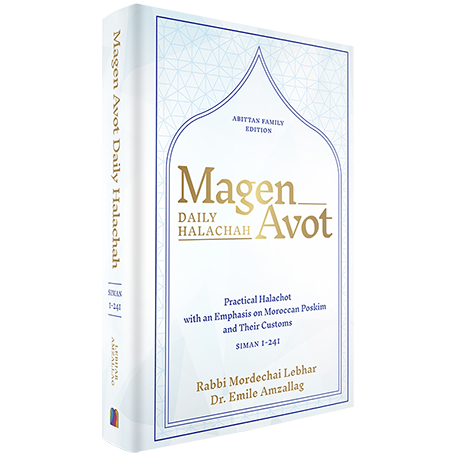
Magen Avot - Daily Halacha
Click here to purchase
Daily Moroccan Halachot
Rabbi Mordechai Lebhar, author Magen Avot
Redacted by Dr. Emile Amzallag

DAILY HALACHOT PODCAST  ON APPLE
  ON SPOTIFY
Daily Halachot Topics
After the Shir Shel Yom, the custom is to recite Kaddish Yehe Shelama, although the Ashkenazim recite it after Alenu Leshabe’ah. The Rama (Orah Haim 132:2) notes that this Kaddish is also called Kaddish Yatom (orphan’s Kaddish) and is normally recited by one who has lost a parent, but may also be recited by one whose parents are both alive and do not object to him reciting it. There are situations in which, fortunately, every congregant’s parents are alive and the rabbis discuss whether or not Kaddish Yehe Shelama need me recited at all. According to the Arizal (Sha’ar HaKavanot) the Shaharit prayer has seven Kaddishim, which act as separators between the different parts of the prayer. Each part of the prayer represents a different spiritual world and the Kaddish helps transition between those worlds. It follows that Kaddish is not just beneficial for the elevation of the souls of the departed, but is also an essential component of the prayer, and therefore even if no one has lost a parent, it should still be recited. Rabbi Ya’akov Moelin (Shu”t Maharil, § 64) declares emphatically that Kaddish Yehe Shelama should still be recited even if none of the congregants have lost a parent. Furthermore, Rabbi Ben Zion Uziel (Shu”t Mishpete Uziel, Orah Haim § 2) writes that the Kaddish should not be ascribed auspicious powers, but rather is a fundamental part of the prayer and should be recited at all times. However, Rabbi Eliezer Deutsch (Shu”t Pri HaSade, vol. 4, § 92) writes that although strictly speaking the Kaddish should be said, if one’s parents will object or if it will be looked upon oddly in the synagogue, the custom is to omit Kaddish. It appears that this common practice is partially because of the superstitious belief that it is inauspicious for someone who has both parents to recite it, although this is incorrect according to the letter of the law. Summary: Strictly speaking, Kaddish Yehe Shelama (aka Kaddish Yatom), should be recited at all times, regardless of whether one of the congregants has lost a parent. There is a Segula to read the Pitum HaKetoret off of parchment, and Rabbi Haim Palagi (Kaf HaHaim 17:18) says that it is propitious for prosperity. These parchments have become popular in recent times and they are usually framed on the wall of the synagogue or are leather-bound for individual use. Nevertheless, the Gemara (Gittin 60a) explains that unless done so in its entirety, the Torah should not be written down. Additionally, the Shulhan Aruch (Yore De’a 283:3) rules that it is not permitted to write down more than three verses of Torah, unless the whole Torah will be transcribed. In extenuating circumstances the principle of “Et La’asot L’Hashem, Heferu Toratecha” is applied. In other words, when there is a great need, Hashem’s laws can be temporarily abrogated for the greater good of the community. Rabbi Ovadia Yosef (Shu”t Yabia Omer, vol. 9, Yore De’a § 23) questions the practice in light of the Gemara’s dictate, and says that a scribe should not write the Pitum HaKetoret on parchment as it contains Torah verses. (However, if it is already written, it may be used). To reconcile this apparent contradiction, Rabbi Avraham HaLevi (Ginat Veradim, Klal 2, § 27) explains that there are several examples of more than three Torah verses being written down, such as on the Parochet, on the Ketuba etc. and that the custom is to be lenient. The source of this leniency is the Rif, who says that if writing the verses is for the purpose of learning, then it is permitted. Reading the Pitum HaKetoret has a positive purpose and, even though the Shulhan Aruch follows the Rambam’s stricter position, the common practice to follow the Rif’s leniency.
Summary: There is a Halachic basis to the leniency of allowing the Pitum HaKetoret to be written on parchment. The Gemara (Berachot 32b) expounds the verse (Tehillim 27:14) “Kave El Hashem, Hazak Ve’ametz Libecha, Vekave El Hashem” (lit. “Hope for Hashem, be strong and He will give your heart courage, and hope for Hashem”) by saying that if one feels that one’s prayers went unanswered, one should pray again. Rabbi Alexander Ziskind (Yesod Veshoresh Ha’Avoda, Sha’ar 14, ch. 4 & 5) explains that this verse is recited near the end of Shaharit so as to reassure those who may feel discouraged about their prayers possibly not being answered. This verse is followed by the liturgical poem of “En K’Elokenu”, in which Hashem is referred to as “Elokenu”, “Adonenu”, “Malkenu” and “Moshienu”. The Arizal explains that these four references each correspond to a different letter of Hashem’s name Yud-Ke-Vav-Ke, while the HIDA (Kesher Gudal ch. 20, § 7) explains that they correlate to the exiles of Babylonia, Persia, Greece and Rome. Rabbi Refael Emmanuel Ricchi (Mishnat Hasidim) writes that this poem is beneficial in thwarting negative spiritual forces.
Summary: En K’Elokenu is a poem of praise which has several meanings. The Zohar (Parashat Vayakhel) explains that one who reads the Pitum HaKetoret daily is protected from harm, both spiritual and physical, as well as from evil thoughts and harsh Divine decrees. Furthermore, as previously mentioned, Rabbi Haim Palagi (Kaf HaHaim 17:18) says that one who reads it will not have the flow of one’s livelihood interrupted even for a moment. One part of the Pitum HaKetoret is the recitation of the eleven ingredients which made up the incense that was used in the Bet HaMikdash. Rabbi Reuven Sofer (Yalkut Reuveni, Seder Ben Kehat, Parashat Ki Tisa) writes that these eleven spices are antidotes to the eleven negative forces of Satan. Rabbi Eliezer Papo (Hesed LaAlafim 132:22) says that since one is already aware of all the personal benefits of the Pitum HaKetoret, one should have in mind to recite in honor of Hashem and not only for one’s own well-being. It should be noted that he explains that one benefits from all the aforementioned rewards only by reciting the Pitum HaKetoret with the proper concentration and intention. Summary: The Pitum HaKetoret has many spiritual benefits. It should be recited intently. The Pitum HaKetoret lists the eleven ingredients that made up the incense that was used in the Bet HaMikdash, and states that if the Kohen who concocted it missed even one ingredient, he was liable to death. Mahari Abuhav explains that in the absence of the Bet HaMikdash, reciting the Pitum HaKetoret comes in place of the actual incense-offering. As such, the Bet Yosef (§ 133), quoting Mahari Abuhav, states that it should only be recited when read from a written source, and not by heart, so as not to accidentally omit any of the spices. The Rama (Darke Moshe, 133:4) writes that it is for this reason that the liturgy of many Ashkenazic communities does not include the Pitum HaKetoret at all. Nevertheless, the Bet Yosef says that the death penalty is only imposed on a Kohen who offers an incomplete incense and not apply to someone who is merely reading the list of spices. As such, one may recite Pitum HaKetoret by heart, but one should still do so with proper concentration. Interestingly, the HIDA (More BeEtzba, § 73) says that it is proper to enumerate the ingredients with one’s fingers as they are being read, so as to ensure that none is omitted. Furthermore, the Ben Ish Hai (Parashat Miketz, § 8) writes that since the Kohen offered the incense with his right hand and that the right hand represents kindness, one should enumerate the spices with the fingers of one’s right hand only. Alternatively, Rabbi Haim Palag (Kaf HaHaim) says that all of one’s fingers should be used so that both hands take part in Mitzvah of the Ketoret. Summary: The Pitum HaKetoret may be recited by memory, but it is proper to use one’s fingers to enumerate the components of the Ketoret as they are being recited. Pitum HaKetoret concludes with the Baraita “Tana Deve Eliyahu”: “Whoever studies Halachot daily is assured a place in the World to Come” (Megila 28b, Nida 73a). The Gemara does not specify how many Halachot one need learn, but Rabbi Yaakov Reischer (Iyun Yaakov, Nida 73b) and the Vilna Gaon (commentary to Mishle 24:30) make a parallel with blessings; just as one should make one hundred blessings daily, so too one should learn one hundred Halachot every day. Nevertheless, Rabbi Avraham ben Natan HaYarhi (Sefer HaManhig) and Rabbi Shlomo Duran (Shu”t HaRashbash, § 52) both apply the principle that the minimum of any plural word (such as “Halachot”) is two, and therefore the Bariata refers to one who learns at least two laws a day. Furthermore, the HIDA (Birke Yosef 152:8) disagrees with the Iyun Yaakov, and says that one should learn two Halachot in the morning, two in the afternoon and two at night, so as to fulfil the precept of “Vehagita Bo Yomam Valaila”, that is, learning the Torah day and night. In any event, the common practice is to learn two Halachot daily, and it is understandable that a person who dedicates one’s time to learn the Torah’s laws has a place in the World to Come. Summary: One should strive to learn at least two Halachot daily. The Shulhan Aruch (Orah Haim 133:1) states that on Shabbat and Yom Tov, “Barechu” is not recited after the last Kaddish. It is explained in Masechet Sofrim (10:7) that “Barechu” was instituted at the end of the prayer for those who may have missed its recital earlier in the prayer. The Zohar (Ruth, pg. 53) states that one who did not respond to “Barechu” will be afflicted with anger that day, and will have an unsettled Neshama. Furthermore, the response to “Barechu” (ie. “Baruch Hashem HaMevorach LeOlam Va’ed”) is made up of five words, corresponding to the five levels of the soul. The Arizal (Pri Etz Haim, Sha’ar Keriat Shema, ch. 1) says that by responding, one allows one’s Neshama to settle in the proper place. Because of its benefits, the Sages instituted the recital of “Barechu” for those that did not hear it earlier. The rationale of the Shulhan Aruch is that even if one arrives late on Shabbat or Yom Tov, one will still be able to hear “Barechu” when the Torah is read. Thus, there is no need to say it at the end of the prayer, and indeed, this is the approach of the Ashkenazic communtiy. Nevertheless, the Sephardic custom is to say “Barechu” before “Alenu Leshabe’ah” of Shaharit (and for that matter, Arvit) everyday of the week because of its Kabbalistic importance. It goes without saying that this only applies if there is a Minyan. Summary: Reciting and responding to “Barechu” has spiritual benefits and is always recited at the end of Shaharit and Arvit. The Geonim (Shu”t HaGeonim, Sha’are Teshuva, § 43) write that Yehoshua bin Nun composed the prayer of “Alenu Leshabe’ah” when he entered the Land of Israel. When he conquered the city of Jericho he reaffirmed that, unlike the “inhabitants of the land” who worship idols, Bnei Israel serve Hashem only, and included this affirmation in the prayer. Furthermore, it is explained that when Yehoshua circled Jericho seven times, he recited “Alenu Leshabe’ah” each time. As such, Rav Hai Gaon explains that Rabban Yohanan ben Zakai instituted “Alenu Leshabeah” at the end of every prayer. Rabbi Elazar Rokeah (Siddur Tefila, § 132) says it was included in the prayer because of Yehoshua’s stature and because it was said when Bnei Israel finally merited entering the Holy Land. Rabbi Moshe ben Machir (Seder HaYom) stresses that this prayer should be said with intense concentration, and goes on to say that some people had a custom of reciting seven times, just as Yehoshua bin Nun did. The central theme of “Alenu Leshabe’ah” is accepting the yoke of Hashem’s kingship and therefore, even though it occurs at the end of the prayer, one should not rush while reciting it. Summary: One should ensure to recite “Alenu Leshabe’ah” deliberately. The Arizal (Sha’ar HaKavanot 50b) writes that when one bows in Alenu Leshabe’ah, namely when saying “VaAnahnu Mishtahavim”, one is enveloped by a protective spiritual light. Practically speaking, the Ben Ish Hai (Od Yosef Hai, Ki Tisa, § 21) explains that the bowing should be done in one movement, rather than bending one’s knees and then bowing. The second paragraph of Alenu Leshabe’ah begins with the words “Al Ken Nekave”, whose initials Rabbi Moshe ben Machir (Seder HaYom) explains spell out the name “Achan”. Achan was among the men who helped Yehoshua conquer Jericho, but he partook in the spoils of war which Yehoshua had consecrated to Hashem. Achan was eventually executed for his sin, but first repented. As such, the Seder Hayom and Rabbi Natan Spira (Mehale Amukot, Va’ethanan) both explain that Achan composed this paragraph and it was included in Alenu Leshabe’ah. The Maharal (Be’er HaGola) and Rabbi Yair Bachrach (Mekor Haim § 132) object to the idea that our Sages would have included a prayer from Achan, and that the actual composer was Yehoshua. Summary: One should bow in one movement when saying “VaAnahnu Mishtahavim”. One should recite “Al Ken Nekave” with concentration. Alenu Leshabe’ah holds deep significance and is replete with allusions. RabbiElazar Rokeah (Sefer HaRokeah) writes that when one recites “Hu Elokenu EnOd Aher” (lit. “He is our G-d, there is none other”), one should have in mind that we no longer have the Bet HaMikdash to atone for our sins and that it is only Hashem Himself who can hear and accept our prayers. Additionally, when onerecites “Mehera Betiferet Uzach” (lit. “quickly with the splendor of Your strength”), one should contemplate the last letters of the words. These three letters when rearranged “Tav-Chaf-He” spell out the Name of Hashem designated to protect Bnei Israel from its enemies and from the spiritual adversaries that may obstruct our prayers. Interestingly, the Arizal (Pri Etz Haim) explains that this was the name that Moshe Rabenu used to kill the Egyptian who was abusing the Jewish slave, and is alluded to in the word “Lama Take Re’echa”. These letters are alluded to in other verses such as “KolHaNeshama Tehalel Y-a Haleluy-a” Summary: One should contemplate the Name spelled “Tav-Chaf-He” while reciting that corresponding portion of Alenu Leshabe’ah.Kaddish Yehe Shelama
Ketoret on Klaf
En K’Elokenu
Pitum HaKetoret
Reciting Pitum HaKetoret from Memory
Tana Deve Eliyahu
Final Barechu
Why was Alenu Leshabe’ah Instituted?
Al Ken Nekave Lach
Secrets of Alenu Leshabe’ah
Sign up for the Daily Moroccan Halachot Email